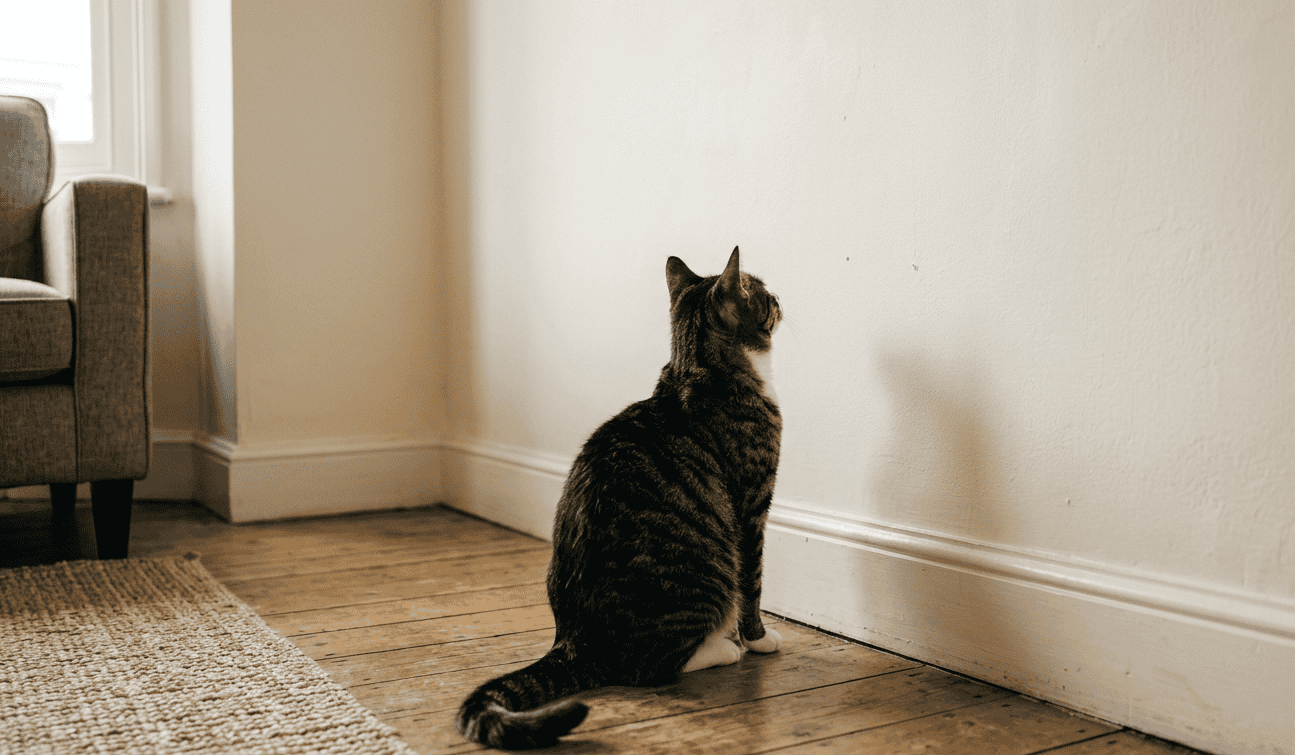
If your cat stare at walls in your apartment has become a daily mystery, the cause is usually sound, scent, movement, boredom, or stress. In most cases, this strange-looking behavior has a simple explanation.
That said, wall staring does occasionally indicate stress, cognitive changes in senior cats, or — rarely — an underlying medical condition. Knowing the difference matters.
This guide covers the nine most common reasons cats stare at walls and empty spaces, with specific attention to apartment cats, whose smaller environment makes the behavior more frequent and more noticeable.
Why Do Cats Stare at Walls?
Cats experience their environment very differently than humans. Their hearing range extends to approximately 65,000 Hz — more than three times the human limit of 20,000 Hz. Their vision is calibrated for detecting motion in low light. They navigate by scent in ways humans cannot replicate.
The result: your cat routinely perceives things that are completely invisible to you. What looks like staring at “nothing” is almost always your cat processing very real sensory input.
In apartments specifically, indoor cats are exposed to a constant stream of hidden stimuli — building sounds, neighbor activity, moving light — that can trigger sustained observation behavior throughout the day.
1. Your Cat Is Hearing Sounds Inside the Wall
The most common explanation for cat wall staring is sound sensitivity. Apartment buildings are full of hidden noise that humans filter out — but cats do not.
Your cat may be reacting to sounds from:
- Water pipes and plumbing
- Electrical wiring and junction boxes
- Heating or HVAC systems
- Neighbor footsteps or voices through shared walls
- Insects or rodents moving inside wall cavities
- Dripping or settling sounds in older buildings
Signs that your cat is tracking sound rather than vision include twitching or rotating ears, head tilting, slow movement along the wall’s surface, and occasional upward glances toward ceilings where pipes or ducts run.
💡 Key Takeaway: If your cat’s ears are moving while they stare at the wall, they are almost certainly listening to something — not spacing out. This is normal and harmless behavior.
2. Your Cat Is Seeing Tiny Movements You Cannot
Cats are visual predators hardwired to detect micro-movement. A cat’s visual system can perceive motion at speeds and scales that are entirely below the human threshold — a single dust mote in a beam of sunlight, a barely-visible insect on a baseboard, or a shadow shifting by a fraction of an inch.
In apartments, movement-based triggers include:
- Small insects (gnats, spiders, silverfish) on walls or ceilings
- Dust particles in streams of sunlight
- Light reflections from phone screens or water surfaces
- Moving shadows cast by ceiling fans or passing vehicles
- Curtain movement from HVAC airflow
- Flickering from older LED bulbs or TVs
Many owners who investigate their cat’s fixed stare find a nearly invisible insect on the wall that they simply had not noticed. Cats are very rarely wrong about this.

3. Your Cat Is Self-Stimulating Due to Boredom
Indoor apartment cats have no access to the environmental variety that naturally occupies outdoor cats. When enrichment is insufficient, cats redirect their observation instincts toward whatever is available — including walls, corners, and ceilings.
Occasional wall observation is normal. The concern is when it becomes a primary daily activity, especially if combined with low movement, flat affect, or reduced interest in play.
Enrichment additions that directly reduce boredom-related wall staring:
- Cat trees and wall shelves — provide climbing and height variety
- Window perches with outdoor views — replaces wall observation with richer visual input
- Puzzle feeders — engage problem-solving instincts at mealtimes
- Interactive wand toys — 15–20 minutes of active play daily is the most effective single intervention
- Rotating toy selection weekly — novelty matters as much as quantity
💡 Key Takeaway: A cat that stares at walls for hours daily may simply need more structured enrichment. Two 15-minute play sessions per day is enough to significantly reduce boredom-driven observation behavior in most apartment cats.
4. Your Cat Is Following Moving Light Patterns
Cats are acutely sensitive to moving light. Light that shifts gradually — such as sunlight tracking across a wall over several hours — can hold a cat’s attention for extended periods without the cat ever appearing to move.
Common apartment light triggers:
- Morning sunlight moving across a wall as the sun rises
- Reflections from glass surfaces, water, or phone screens
- Headlights or streetlights passing through windows at night
- LED flicker from older smart bulbs (often imperceptible to humans)
- Neighbor window light patterns through shared walls or gaps
If your cat stares at the same wall at the same time each day, track the natural light in that room during that window. You will very likely identify a repeating light pattern your cat has learned to anticipate.
5. Your Cat’s Hunting Instincts Are Activated
Domestication has not eliminated the predator instinct in cats. Even indoor cats that have never hunted retain the neurological drive to stalk, wait, and pursue prey — and they apply that programming to their immediate environment.
A wall or corner becomes a persistent hunting zone when your cat previously noticed:
- An insect — spider, fly, silverfish, or moth
- A sound suggesting prey activity inside the wall
- A scent trail left by an insect along a baseboard
- Any prior micro-movement in that location
Cats remember locations associated with past prey activity and will return to surveil them — sometimes for days — even after the stimulus is gone. This patient, still waiting behavior is instinctive predator strategy, not confusion.

6. Your Cat May Be Stressed or Hypervigilant
When wall staring is intense, frequent, and accompanied by other behavioral changes, stress is a meaningful possibility. Apartment cats face a specific set of stressors that outdoor cats do not — shared walls, elevator noise, inconsistent building sounds, and close proximity to other animals they cannot see but can hear.
A stressed or anxious cat may become chronically hypervigilant, spending excessive time scanning walls and ceilings for threats that their nervous system has flagged as present.
Stress-specific stressors in apartment environments include:
- Loud or unpredictable neighbor activity
- Dogs audible through shared walls or hallways
- Building construction or renovation noise
- Elevator sounds and mechanical vibration
- New people entering the apartment frequently
Stress signs that accompany wall staring and warrant attention: hiding more than usual, reduced appetite, overgrooming or fur loss, sudden aggression, consistently dilated pupils, and startling easily at ordinary sounds.
💡 Key Takeaway: Stress-related wall staring doesn’t look like curious staring. It looks rigid, sustained, and often accompanies a tense body posture. Adding quiet hiding areas and vertical escape routes helps apartment cats feel more secure.
7. Senior Cats May Be Experiencing Cognitive Changes
Older cats — typically those 11 years and above — can develop Feline Cognitive Dysfunction Syndrome (FCDS), a neurological condition comparable to dementia in humans. Blank or sustained wall staring is one of its recognized behavioral markers.
Additional age-related changes that can produce increased wall staring include vision and hearing decline (which disrupts normal sensory processing) and altered sleep-wake cycles (which can produce confusion or disorientation during nighttime hours).
Signs that distinguish cognitive-decline staring from normal behavior:
- Getting disoriented in a familiar apartment layout
- Vocalizing at night for no apparent reason
- Forgetting the location of the litter box
- Reduced recognition of familiar people or objects
- Increased anxiety without identifiable cause
If your senior cat has recently developed persistent wall staring and any of the above signs are present, a veterinary checkup is the right next step. FCDS is manageable, and early identification improves quality of life significantly.

8. Medical Conditions Can Sometimes Cause Abnormal Wall Staring
In a minority of cases, wall staring is a symptom of an underlying health problem rather than a behavioral one. The key distinguishing factor is whether the staring is accompanied by physical or neurological symptoms.
Medical conditions associated with abnormal staring behavior in cats include:
- Hypertension (high blood pressure) — can cause retinal changes, visual disturbances, and disorientation
- Partial seizure disorders — focal seizures sometimes present as fixed staring or sudden behavioral freezing
- Neurological conditions — brain lesions or inflammation can produce staring, head pressing, or circling
- Vision impairment — a cat adjusting to partial sight loss may stare or appear confused in familiar spaces
- Feline cognitive dysfunction — as described above
Seek veterinary attention promptly if wall staring is accompanied by any of the following: unresponsiveness when called, physical disorientation or stumbling, head pressing against walls or furniture, repetitive pacing or circling, or apparent loss of vision.
💡 Key Takeaway: Normal wall staring ends when something more interesting happens. A cat that cannot be interrupted from staring — even with food or touch — may be experiencing a medical episode and should be seen by a vet.
9. Sometimes Your Cat Is Simply Being a Cat
Cats are not humans. They do not require constant visible activity to be mentally engaged. Cats naturally spend 12–16 hours per day resting, and a significant portion of their waking time is devoted to quiet, still observation of their environment — a behavior that is deeply wired and serves real territorial and predatory functions.
Humans interpret stillness as boredom or strangeness because we expect obvious activity. For cats, watching a wall quietly may simply be how they process, monitor, and inhabit their space.
In apartments, this behavior becomes more visible because there is less space to observe, making any sustained focus more noticeable. The wall staring hasn’t changed — the setting just makes it easier to see.

When Should You Worry About Cat Wall Staring?
The behavior itself is rarely the problem. What matters is whether the staring is accompanied by other changes in health or behavior.
Contact your veterinarian if your cat’s wall staring is paired with any of the following:
- Sudden personality or behavior change
- Confusion or disorientation in a familiar space
- Unresponsiveness when touched or called by name
- Loss of coordination or stumbling
- Head pressing against walls or objects
- Repeated staring episodes that look like freezing
- Loss of appetite lasting more than 24–48 hours
- Excessive or unusual vocalization, especially at night
- Seizure-like muscle twitching or involuntary movement
A single episode of focused wall staring is never a reason for concern. A pattern of staring that is new, uninterruptible, or accompanied by any of the above is worth a vet conversation.
How to Reduce Excessive Wall Staring in Apartment Cats
If the staring is frequent but benign, increasing environmental richness is the most effective intervention. Apartment cats that have adequate stimulation spend less time fixating on walls because they have more interesting things to engage with.
Interactive play: Use wand toys or feather teasers for two structured sessions daily — morning and evening align best with a cat’s natural crepuscular activity cycle.
Vertical space: Wall shelves and cat trees give cats a richer territory to patrol. More territory = less fixation on a single spot.
Window access: A window perch with an outdoor view provides a continuous stream of real visual and auditory input — far richer than a blank wall.
Puzzle feeders: Replace one or both daily meals with a puzzle feeder to engage problem-solving instincts and break up the observation-and-rest cycle.
Predictable routine: Cats are creatures of habit. A consistent daily schedule reduces ambient anxiety and the hypervigilance that drives compulsive environmental monitoring.
Quiet retreat zones: Give your cat at least one enclosed, private space — a covered bed, a box, a shelf with a back — where they can rest without monitoring. Safety reduces surveillance behavior.
Why Apartment Cats Stare at Walls More Than Other Cats
Apartment living does not cause wall staring — but it concentrates it. Indoor apartment cats have a smaller sensory territory than outdoor cats, so they apply the same observational intensity to a more limited set of stimuli.
Compared to outdoor or larger-home cats, apartment cats typically:
- Become attuned to recurring building sounds (pipes, elevators, neighbors)
- Develop stronger sensitivity to routine disruptions
- Spend more waking hours in observation mode because patrol territory is limited
- Focus more intensely on individual stimuli (a single shadow, a specific pipe sound)
Understanding this context makes apartment cat behavior less alarming and easier to address. The behavior is the same — the setting just makes it more visible.
Take our Quiz to Understand Your Cat’s Personality and Behaviors
Final Thoughts
If your cat is staring at a wall, the overwhelming likelihood is that they are detecting a sound, movement, or light pattern that you cannot perceive. It is normal feline behavior that becomes more noticeable in small apartments because the environment concentrates it.
The cases that warrant concern are clearly distinguishable: staring accompanied by unresponsiveness, physical symptoms, sudden behavioral changes, or patterns that appear only in senior cats or have developed rapidly. In those cases, a vet visit is the right call.
For the vast majority of apartment cats, though, the wall is just more interesting than it looks.
Frequently Asked Questions: Cat Wall Staring
Why does my cat stare at the wall and meow?
Staring at the wall while meowing usually means your cat has detected something behind the wall — most likely an insect, rodent, or pipe sound — and is vocalizing from excitement or frustration that they cannot reach it. It is common in apartment buildings and generally harmless.
Is it normal for cats to stare at nothing?
Yes. Cats are not staring at “nothing” — they are processing sensory input that humans cannot detect. Their hearing range (up to 65,000 Hz) and motion sensitivity far exceed human capability. What looks like an empty wall almost always contains a sound, vibration, or micro-movement your cat has identified.
Why does my cat stare at the same spot on the wall every day?
Cats stare repeatedly at the same location because they associate it with past activity — a sound that occurs at the same time of day (a pipe, HVAC cycle, or neighbor routine), a recurring light pattern, or a scent trail from a previous insect. The consistency of the behavior reflects the consistency of the underlying trigger.
Can cats see things humans cannot?
Yes. Cats cannot see more colors than humans (their color range is actually narrower), but they dramatically outperform humans in motion detection, peripheral vision, and low-light sensitivity. They also hear a far wider frequency range, which means building sounds that are inaudible to you are clearly audible to your cat.
Should I be worried if my cat stares at walls at night?
Nighttime wall staring is especially common because cats are crepuscular (most active at dawn and dusk), building sounds change at night, and moving light from passing vehicles creates new shadows. It is typically harmless. However, if your senior cat vocalizes while staring at night and seems disoriented, this may indicate cognitive dysfunction and is worth discussing with a vet.
What is head pressing in cats, and how is it different from wall staring?
Head pressing is when a cat pushes their head directly and persistently against a wall or solid object — not looking at it, but physically pressing into it. This is a neurological warning sign associated with high blood pressure, brain lesions, or poisoning and requires immediate veterinary attention. It looks very different from normal wall staring.


Leave a Reply