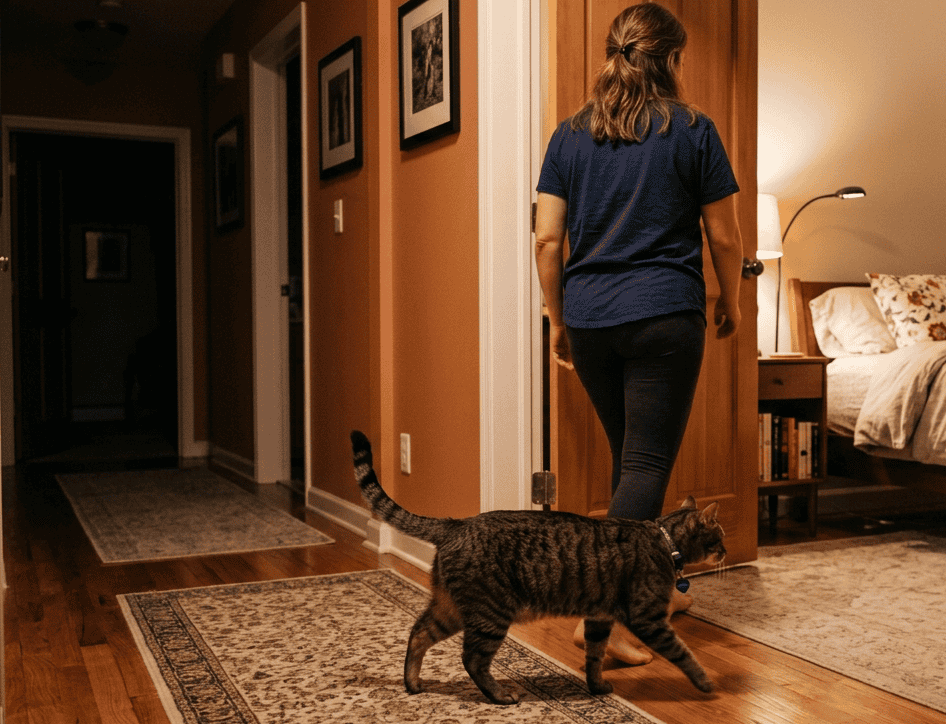
Clingy cat behavior can feel intense in a small apartment because your cat is always nearby. However, following you from room to room is often a mix of affection, routine, curiosity, and a need for reassurance.
Cats follow their owners everywhere primarily because of bonding, curiosity, learned routine, and the spatial reality of small apartments — not because something is wrong. In most cases, a cat that shadows you throughout the day is expressing trust, not anxiety.
That said, there is a meaningful difference between healthy attachment and the early signs of feline separation anxiety. This guide covers all ten reasons, what each one looks like in practice, and exactly when the behavior warrants a closer look.
Why Does My Cat Follow Me Everywhere? 10 Reasons Explained
Following behavior — sometimes called “shadow cat” behavior — is one of the most common things apartment cat owners report. Understanding why it happens requires looking at three things together: feline psychology, the physical constraints of small living spaces, and the specific bond between a cat and its primary person.
In apartments especially, the behavior intensifies because your cat’s entire territory is one unit — and you are its most dynamic, unpredictable element. Every time you move, something potentially relevant to your cat is happening.
1. Your Cat Is Genuinely Bonded to You
The most common reason a cat follows its owner is simply a strong social bond. Despite their reputation for independence, domestic cats — particularly indoor ones — form secure attachments to their primary humans in ways that parallel attachment patterns seen in other social mammals.
In an apartment, you become the primary source of safety, warmth, routine, and stimulation. It makes complete sense for your cat to stay close to that source.
Signs of healthy, secure attachment (as opposed to anxious attachment):
- Following you between rooms but settling independently once you stop
- Choosing to sit near you rather than always on you
- Slow blinking and relaxed, loose body posture
- Calm greetings when you return home — not panicked ones
- Normal eating, sleeping, and play behavior throughout the day
💡 Key Takeaway: A cat that follows you but remains calm, eats normally, and plays independently is showing healthy attachment — not a behavioral problem. The following is a feature of the bond, not a flaw in it.

2. Small Apartment Spaces Physically Amplify Following Behavior
In a large house, a cat can “follow” its owner while remaining in a separate room, maintaining comfortable social proximity without constant visibility. In a studio or one-bedroom apartment, that buffer distance simply does not exist.
What reads as intense clinginess in a small space would be invisible in a larger one. The behavior itself may be the same — the apartment just makes it obvious.
Specific ways small apartments intensify shadow behavior:
- Fewer rooms means fewer independent resting destinations away from human movement
- Human movement paths overlap with all of the cat’s territory
- Sound and scent cues travel across the entire apartment instantly
- Your cat learns your routine faster because the environment offers fewer variables
💡 Key Takeaway: Before concluding your cat is unusually clingy, consider whether the apartment itself is collapsing the natural distance. In most small spaces, the cat hasn’t changed — the space has just removed the room for separation.
3. You Are the Most Interesting Thing in the Apartment
Cats are natural observers and opportunists. In a small indoor environment with limited stimulation, the owner becomes the primary source of novelty. Every movement you make is potentially meaningful data.
From your cat’s perspective, your daily actions map to specific possibilities:
- Moving toward the kitchen = food possibility
- Opening a cabinet = new smell, new object, new sound
- Sitting down = potential lap access or play session
- Going to the bathroom = water sounds, unfamiliar territory
- Putting on shoes = your imminent departure — a significant event
Following you is a rational information-gathering strategy for a curious animal in a small, relatively static environment. It is not neediness — it is intelligence.

4. Learned Routine: Your Cat Has Conditioned You as Much as You’ve Conditioned Them
Cats are highly efficient pattern learners. If following behavior has ever been rewarded — even unintentionally — it becomes a reinforced habit. Most owners do this without realizing it.
The conditioning cycle typically looks like this:
- Cat follows you to the kitchen
- You feed them, pet them, or make eye contact
- Cat associates following with a positive outcome
- Behavior repeats and strengthens over weeks
The reward doesn’t need to be food. Talking to your cat, brief eye contact, or even just acknowledging them as you pass is enough positive reinforcement to sustain and strengthen the behavior over time.
5. Boredom: You’ve Become a Substitute for Enrichment
When an indoor cat does not have sufficient mental stimulation, its owner becomes the default source of entertainment. In this case, the following behavior is not about attachment — it is about need. And addressing the underlying boredom is more effective than trying to reduce the following itself.
Signs that boredom — rather than bonding — is driving the following:
- Following is accompanied by persistent vocalization or pawing
- Your cat frequently interrupts your work or activities
- Restlessness when you stop moving
- Little interest in toys or independent play
This pattern is especially common in single-cat households in studios or small one-bedroom apartments, where the cat has no companion animal and limited environmental complexity.
💡 Key Takeaway: If your cat follows and vocalizes or physically demands attention, the issue is likely insufficient enrichment rather than over-attachment. Two 15-minute interactive play sessions daily typically reduces this pattern significantly within one to two weeks.

6. Feline Separation Anxiety: When Following Crosses Into Distress
While most following behavior is benign, a subset of cats develop genuine separation anxiety — a recognized behavioral condition in which the cat experiences significant distress when separated from its primary attachment figure. The distinction between healthy bonding and separation anxiety lies in what happens when you are absent or unavailable, not just in how closely they follow when you are present.
Warning signs that suggest separation anxiety rather than typical following behavior:
- Excessive meowing, yowling, or scratching when you leave or enter another room
- Reduced appetite or refusal to eat when alone
- Destructive behavior near doors or exits
- Inappropriate elimination that occurs only when alone
- Overgrooming or fur pulling when the owner is absent
- Inability to settle independently for even short periods
Common triggers for developing separation anxiety in apartment cats include abrupt schedule changes (returning to an office after remote work), a recent move, rehoming history, or a single-cat household where the owner is the cat’s only social contact.
If these signs appear consistently across multiple days, behavioral adjustment strategies — or a consultation with a feline behaviorist — are more appropriate than simply accepting the behavior.
7. Breed and Individual Personality Make Some Cats More Prone to Following
Some cats are genetically and temperamentally predisposed to high social engagement with humans. Individual personality is a stronger predictor than breed alone, but certain breed tendencies are well established.
Breeds commonly associated with owner-following behavior include Siamese (highly vocal and social), Ragdoll (affection-seeking, often described as “dog-like”), Burmese, and Maine Coon. Hand-raised kittens — regardless of breed — also tend toward stronger human attachment than mother-raised cats.
That said, environment modifies temperament significantly. Even naturally independent breeds can develop strong following behavior after months of apartment life as a single indoor cat with limited stimulation.
Take This Quiz: Find Your Ideal Cat Breed and Personality Match
8. When Following Behavior Is Completely Normal
The majority of apartment cats that follow their owners throughout the day are doing so for healthy reasons. Following behavior is generally not a concern if the cat meets all of the following criteria:
- Eats and drinks normally on a regular schedule
- Sleeps without visible distress (typically 12–16 hours per day)
- Engages in some independent play or self-directed activity
- Tolerates short periods of owner absence without visible panic
- Displays relaxed body language — loose posture, slow blinks, neutral tail
A cat that checks all these boxes and also happens to follow you to the kitchen every morning is simply a well-bonded apartment cat — not a problem to solve.
9. How to Reduce Excessive Following Without Damaging the Bond
If the following behavior has become disruptive — interrupting work, preventing sleep, or simply overwhelming — the goal is not to eliminate the attachment but to build your cat’s capacity for independent comfort. The most effective interventions work by making your cat’s environment richer, not by making you less available.
Create designated “safe zones”: A cat that has satisfying resting spots — a tall cat tree, a window perch with a view, a covered bed in a quiet corner — has reasons to stay put that compete with following you. The environment should be interesting enough to hold attention on its own.
Add structured enrichment: Two 10–15 minute interactive play sessions daily (wand toys, feather teasers) and puzzle feeders at mealtimes address the boredom component of following without requiring any reduction in affection.
Encourage independent play: Start a play session, then gradually disengage before your cat is fully satisfied. This builds tolerance for self-directed activity and reduces the expectation that all play requires your active participation.
Stop inadvertently reinforcing constant following: When your cat follows you and you immediately give attention, you are conditioning the behavior. Waiting a few seconds before responding — and rewarding calm, settled behavior with attention instead — shifts the reinforcement pattern over time.
Maintain a consistent daily routine: Predictable feeding times, scheduled play sessions, and a regular sleep schedule reduce ambient anxiety. Cats that feel secure in their routine are less likely to follow as a form of reassurance-seeking.

10. What Your Cat’s Following Behavior Is Actually Telling You
Viewed through the right lens, a cat that follows its owner is communicating something meaningful. In a small apartment, your cat’s world is defined by a single space and a single primary relationship. Following you is how they participate in that relationship, stay informed about their territory, and maintain proximity to their anchor of safety.
Understanding that context turns the behavior from something to manage into something to interpret. When the following is calm and flexible, it means trust. When it is frantic and relentless, it means need. The response to each is different — and recognizing which one you’re looking at is the most important step.
Final Thoughts
If your cat follows you from room to room all day, you are almost certainly seeing a combination of genuine bonding, curiosity, learned routine, and the simple spatial reality of apartment living. In most cases, it is a sign of a well-adjusted cat with a secure relationship to its owner.
Watch for the difference between calm, flexible following — which is healthy — and distressed, relentless following that intensifies when you are absent. The first needs no intervention. The second benefits from enrichment, routine, and in persistent cases, a conversation with a vet or behaviorist.
Most of the time, your shadow cat is simply telling you: “You are my safe place, and I like being where you are.” In a small apartment, that closeness just becomes a little more visible than it would anywhere else.

Frequently Asked Questions: Cats Following Their Owners
Why does my cat follow me to the bathroom?
The bathroom is one of the few places in an apartment where you regularly close a door — making it inherently more interesting to a cat conditioned to monitoring your movements. Water sounds, unfamiliar smells, and the novelty of a closed door all attract feline curiosity. It is entirely normal behavior and requires no intervention.
Is it bad that my cat follows me everywhere?
No, in most cases. Following behavior is a normal expression of feline bonding and curiosity, especially in small apartments. It becomes a concern only when accompanied by signs of distress — panic when you leave, refusal to eat alone, destructive behavior near exits, or compulsive vocalizing. Calm following with otherwise normal behavior is a healthy sign.
Do cats follow you more in small apartments?
Yes. In larger homes, cats can maintain social proximity while remaining in a separate room. In studios and small apartments, the floor plan eliminates that buffer. The same level of attachment produces visibly more following behavior simply because there is less physical space between you and your cat at any given moment.
What is the difference between a clingy cat and a cat with separation anxiety?
A clingy cat follows you, seeks proximity, and may vocalize for attention — but remains calm when you leave and functions normally alone. A cat with separation anxiety shows distress specifically when separated: excessive meowing, destructive behavior, inappropriate elimination, or refusal to eat. The key is what happens in your absence, not just your presence.
Why does my cat follow me and then not want to be touched?
This is characteristic of cats that seek social proximity without physical contact — a completely normal attachment style. Your cat wants to be near you and monitor your activities without necessarily being held or petted. Respecting this preference, rather than forcing contact, typically strengthens the bond over time.
Can following behavior be reduced without hurting the relationship?
Yes. The most effective approach is increasing environmental enrichment — cat trees, window perches, puzzle feeders, and daily interactive play — so the apartment becomes interesting enough to hold your cat’s attention independently. Avoid punishing following behavior; instead, reward calm and settled behavior with attention to shift the reinforcement pattern gradually.


Leave a Reply