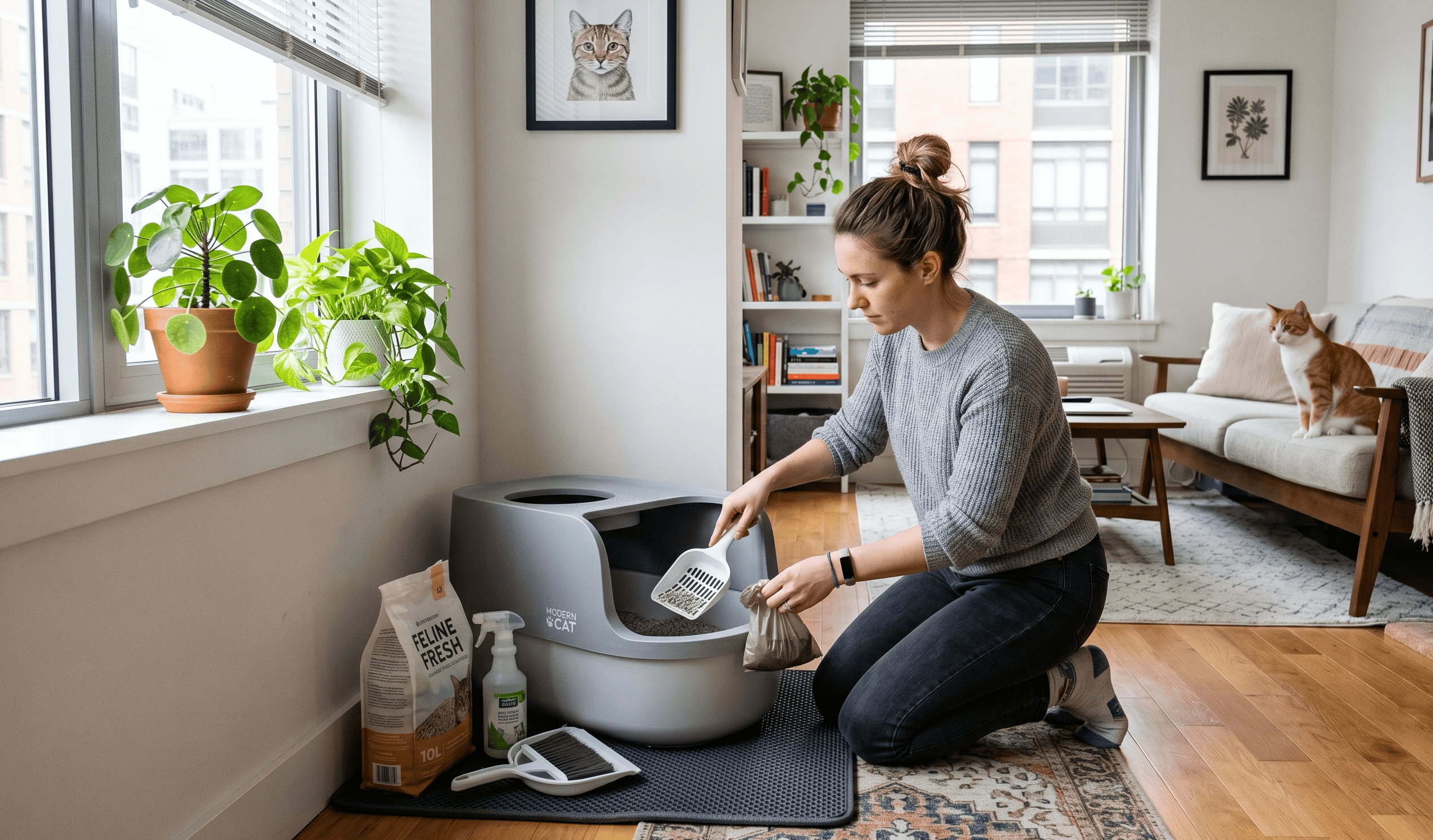
How Often Should You Clean a Cat Litter Box?
Living with a cat in an apartment is wonderful — until the litter box smell takes over. Unlike houses with multiple rooms and better ventilation, apartments concentrate odors fast. The good news? A consistent, vet-backed cleaning schedule can eliminate litter box smell almost entirely, even in a studio.
This guide answers the most common question apartment cat owners ask: how often should you clean a litter box? We’ll break it down by task, number of cats, and litter type — so you can build a routine that actually works.
The Short Answer: How Often to Clean a Litter Box
| Task | Frequency |
|---|---|
| Scooping waste | At least once daily (twice is ideal) |
| Refreshing/topping off litter | Every 2–3 days |
| Full litter change | Weekly (clumping) or every 2–3 days (non-clumping) |
| Deep scrub with soap and water | Every 2–4 weeks |
| Replacing the litter box itself | Every 1–2 years |
This schedule is the baseline recommended by most veterinarians and aligns with guidance from the American Association of Feline Practitioners (AAFP). In a small apartment, sticking to the high end of this frequency is strongly advised.
Why Apartment Living Demands a Stricter Schedule
In a house, litter box odors can dissipate across more space. In a 500-square-foot apartment, there’s nowhere for the smell to go. Poor ventilation, open floor plans, and proximity to living and sleeping areas make odor control a genuine quality-of-life issue — for you and your cat.
Cats are also notoriously clean animals. If their litter box is too dirty, they’ll avoid it and find somewhere else to go. That means your couch, your laundry pile, or worse.
A clean litter box isn’t just about your nose — it’s about your cat’s health and behavior.
Already struggling with smell? Read our companion guide: How to Stop Litter Box Smell in Small Spaces
Step-by-Step Litter Box Cleaning Schedule
Daily: Scoop Every 24 Hours (Minimum)
This is non-negotiable. Scoop solid waste and urine clumps once a day at a minimum. If you have a sensitive nose or your cat uses the box frequently, scooping morning and evening makes a significant difference.
Why it matters: Ammonia from urine builds up within hours in a small space. Daily scooping removes the source before it becomes a problem.
Pro tip: Keep a dedicated scoop and a small covered trash can right next to the litter box. The less friction in the routine, the more consistent you’ll be.
Every 2–3 Days: Top Off the Litter
After scooping, litter levels drop. Low litter means less absorption and more odor. Keep clumping litter at about 3–4 inches deep. Top it off every two to three days to maintain that depth.
Weekly: Full Litter Replacement (Clumping Litter)
Even with diligent scooping, fine litter particles absorb odors over time and become saturated. Once a week, dump the entire contents, give the box a quick rinse, dry it, and refill with fresh litter.
For non-clumping litter: Change it entirely every 2–3 days. Non-clumping litter doesn’t trap urine in solid clumps — it pools at the bottom and degrades much faster.
Every 2–4 Weeks: Deep Clean the Box
Once or twice a month, do a proper scrub:
- Empty all litter into the trash (never down the drain — it can clog pipes).
- Wash the box with warm water and unscented dish soap.
- Avoid bleach or heavily scented cleaners — the strong smell can deter cats from using the box.
- Dry thoroughly before adding fresh litter. Moisture trapped under litter accelerates bacterial growth and odor.
This deep clean removes residue that daily scooping misses and resets the odor baseline.
Every 1–2 Years: Replace the Box Entirely
Plastic litter boxes develop micro-scratches over time from scooping. These scratches harbor bacteria and absorb odors no amount of washing can fully remove. If your box is older than two years, it’s time for a new one — regardless of how clean it looks.
How Many Litter Boxes Do You Need in an Apartment?
The standard veterinary recommendation is one litter box per cat, plus one extra. So:
- 1 cat → 2 litter boxes
- 2 cats → 3 litter boxes
In an apartment, this can feel like a lot of real estate. But two boxes dramatically reduce odor buildup between cleanings and prevent territorial stress if you have multiple cats. They don’t have to be large — a slim covered box can fit in a bathroom corner or closet nook.
If space is genuinely too tight for two boxes, increase your scooping frequency to twice daily and do weekly deep cleans to compensate.
Cleaning Schedule by Litter Type
Different litters have different lifespans and odor-control properties. Here’s how the schedule adjusts:
Clumping Clay Litter
The most common type. Urine binds into hard clumps that are easy to scoop. Full replacement needed weekly with deep clean every 2–4 weeks. Most cost-effective option.
Silica Gel / Crystal Litter
Absorbs urine without clumping. Stir daily to expose fresh crystals. Full replacement every 3–4 weeks for one cat (sooner for multiple cats or heavy users). Low dust, excellent odor control — a strong choice for apartment living.
Plant-Based / Biodegradable Litter (Corn, Wheat, Pine)
Varies by brand, but generally needs full replacement every 5–7 days. Some clump, some don’t. Excellent for odor in the short term but can degrade faster than clay. Check manufacturer recommendations.
Non-Clumping Clay Litter
Requires the most frequent full replacement — every 2–3 days. Not ideal for apartments due to higher maintenance and odor accumulation between changes.
Signs You’re Not Cleaning Often Enough
Your cat will tell you before your nose does. Watch for these behavioral cues:
- Going outside the box — the most obvious sign the box is too dirty
- Scratching excessively or hovering — trying to find a clean spot
- Perching on the edge of the box — avoiding contact with soiled litter
- Eliminating right next to the box — the cat wants to use it but won’t get in
If you notice any of these, increase scooping frequency immediately and do a full deep clean.
Odor Control Boosters for Apartment Dwellers
A good cleaning schedule is your foundation, but these additions make a meaningful difference in a small space:
- Baking soda — sprinkle a thin layer at the bottom of the box before adding litter. Natural odor absorber, safe for cats.
- Litter box deodorizer — look for unscented formulas. Strong fragrances can repel cats.
- Air purifier with a HEPA and activated carbon filter — placed near the litter area, these capture airborne particles and VOCs (volatile organic compounds) that cause odor.
- Ventilation — keep a nearby window cracked when possible, especially right after scooping.
- Covered vs. uncovered boxes — covered boxes trap odor inside the box rather than dispersing it into the room. Better for you; some cats dislike them. Try both and see what your cat tolerates.
For a full breakdown of odor management strategies, see our Litter & Odor Control Guide.
What Vets Actually Recommend
We hear a lot of conflicting advice online, so here’s what the veterinary consensus looks like:
- Dr. Karen Becker (integrative veterinarian) recommends scooping at minimum once daily and ideally twice, calling it “the single most important thing you can do for litter box hygiene.”
- The AAFP advises one box per cat plus one, cleaned daily, with complete litter changes at least weekly.
- Cornell Feline Health Center notes that cats are highly sensitive to litter box conditions and that a dirty box is one of the top behavioral causes of inappropriate elimination.
The through-line: daily scooping is the one thing every expert agrees on. Everything else is supporting that baseline.
Quick-Reference Cleaning Schedule (Save This)
✅ Daily → Scoop solid waste and urine clumps✅ Every 2–3 days → Top off litter to 3–4 inch depth✅ Weekly → Full litter dump and rinse (clumping litter)✅ Every 2–4 weeks → Deep scrub with soap and water✅ Every 1–2 years → Replace the entire litter box
Final Thoughts
Keeping a litter box clean in an apartment takes about five minutes a day. That’s genuinely all it takes when you stick to the schedule. The mistake most cat owners make isn’t laziness — it’s inconsistency. Miss two days and you’re playing catch-up with odor, bacterial buildup, and a frustrated cat.
Build the daily scoop into an existing habit (right after your morning coffee, right before bed) and the rest of the schedule follows naturally.
Not sure if your apartment setup is working for your cat overall? Take our Apartment Cat Readiness Quiz to find out — and use the Cat Cost Calculator to budget for litter, boxes, and everything else that comes with apartment cat ownership.
Have questions about litter box routines or odor control? Drop them in the comments — we answer every one.


Leave a Reply